Buy enough energy for the day you actually have
A 10,000mAh power bank beside a phone with a 5,000mAh battery looks like two full refills. That calculation skips the voltages behind those numbers and the losses between the two batteries. It can leave you buying a pack that meets the arithmetic but misses your evening train.
This guide covers choosing a power bank for wired USB-C phone charging. Start with the top-ups you need, compare energy in watt-hours, then check the port’s charging capabilities. Wireless charging and laptop power requirements need their own allowance; neither follows automatically from a large capacity number.
Write a concrete requirement before shopping: “Bring my phone from roughly 20% to 80% once during a workday, with some reserve.” That is a more useful buying target than “the largest mAh I can afford.” It also gives you a repeatable acceptance check after delivery.
Make three separate entries from the label
With the power bank disconnected, turn it over and look along its underside and edges for the printed specification label. Photograph the small print or enlarge the seller’s label photograph. Keep the model number in the same note as the figures; similarly named products can have different outputs.
The pink example shows where a manufacturer has placed capacity and DC input/output markings on the casing. It is an older physical label example, not a USB-C recommendation. Its small label does not supply every specification needed for this buying exercise.
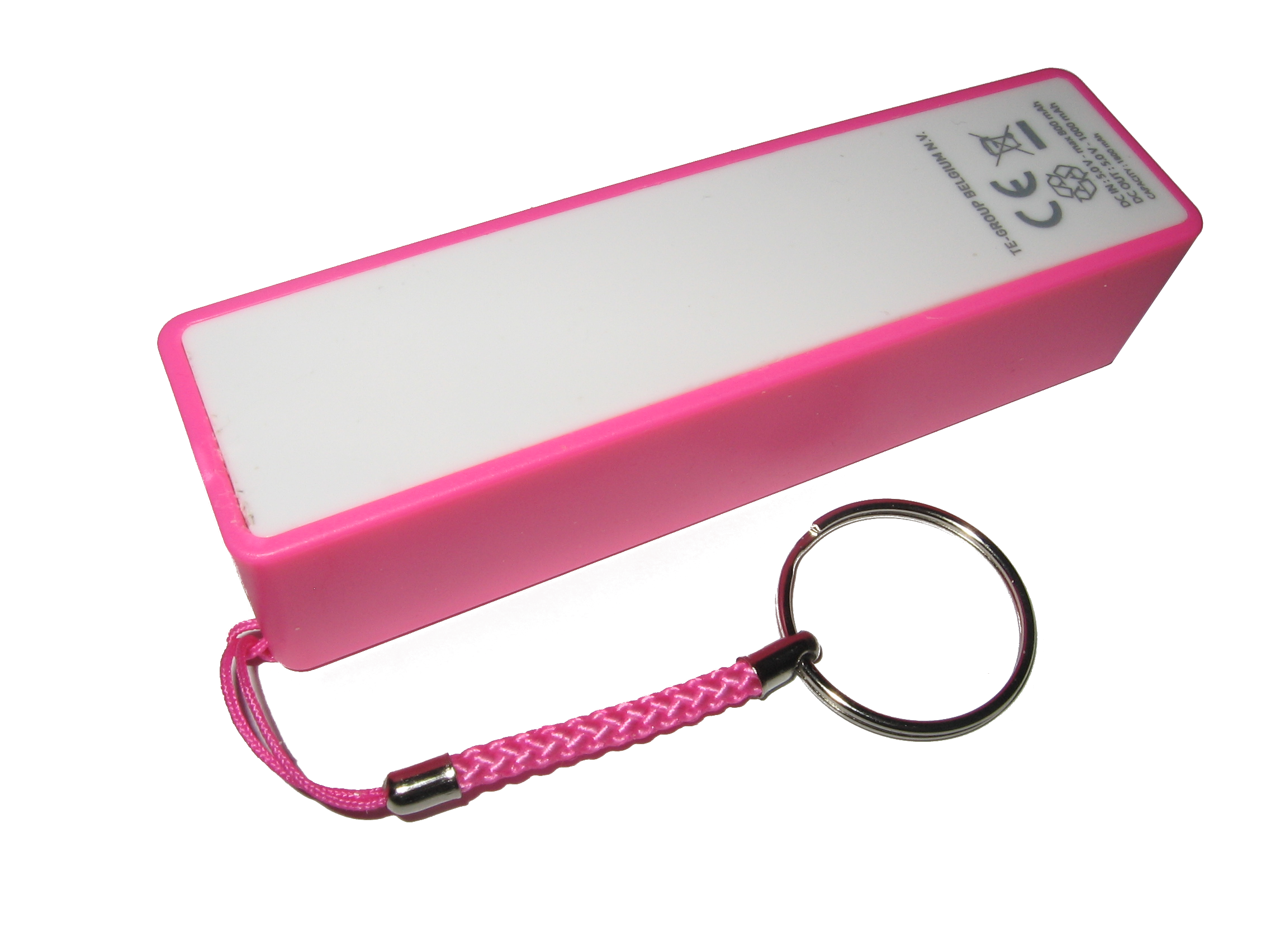
Look for the small specification print on the outside of the casing. This older example locates capacity and DC input/output markings; it does not provide every field needed for the worked comparison. Keep your own power bank assembled.
Version notes
Evergreen physical label-inspection photograph dated 23 November 2015, checked 31 October 2026. Older casing shown for label location only; no current availability, USB-C support, measured capacity or fast-charging capability inferred. Full original PNG retained unchanged. Display photograph resized for loading speed; the full-size link preserves the original download.- Stored energy: copy the battery or cell capacity and its nominal voltage, preferably the manufacturer’s Wh figure. If only mAh is stated, ask for the cell voltage or Wh rather than assuming every battery uses the same voltage.
- Delivered capacity: look for rated output capacity together with its output voltage and any stated test current. Keep the entire condition. A bare “6,000mAh rated” leaves a crucial part of the comparison unanswered.
- Charging power: copy the output specifications for the exact USB-C port you plan to use, and the total output when several devices are connected. Put the input specification on a separate line: it describes recharging the bank.
Save the official specification page, not just a marketplace title. When a seller cannot provide a readable label or model-specific manual, your comparison has an evidence gap. Leave the missing field marked unknown and prefer a candidate whose documentation answers it.
Put both sides of the comparison in watt-hours
Milliampere-hours describe electrical charge. Watt-hours describe energy and include voltage: Wh = mAh × nominal volts ÷ 1,000. Anker’s capacity explanation distinguishes cell energy, power-bank conversion losses and further losses inside the receiving device.
For a hypothetical pack labeled 10,000mAh at 3.7V, stored energy is 37Wh. Before allowing for any losses, that equals 7,400mAh at a 5V output. The lower mAh number here is a change of voltage basis, not evidence that energy vanished. Conversion losses then reduce the energy actually delivered.
Energizer’s capacity FAQ explains why output capacity is lower and gives an efficiency-based calculation. Treat any efficiency you supply yourself as an assumption, not a product specification.
| Candidate | Advertised cell capacity | Rated output capacity | Output energy |
|---|---|---|---|
| A | 10,000mAh | 6,000mAh at 5V | 30Wh |
| B | 10,000mAh | 6,500mAh at 5V | 32.5Wh |
These invented candidates illustrate a comparison, not measured products. B lists about 8% more output energy under the assumed matching conditions. That difference may matter less to you than weight or price, but the headline cell capacity would have hidden it. Ratings at different currents or voltages are not directly equivalent performance tests.
When a rated output capacity is supplied, its conversion to Wh already represents the stated output allowance. Do not subtract power-bank conversion loss from that figure again. If only cell Wh is available, keep it labeled stored energy and retain uncertainty about usable output.
Translate a top-up into a buying margin
Find the phone battery’s Wh in its official technical documentation if available. A USB charging voltage is not the battery’s nominal voltage; do not multiply the phone’s battery mAh by 9V merely because it accepts 9V charging.
Consider a hypothetical phone with a 19Wh battery. Moving from 20% to 80% represents roughly 60% of its capacity, or 11.4Wh stored. If, purely for this example, 85% of USB input energy reaches the battery, that top-up requires about 13.4Wh at the phone input. Two such top-ups require roughly 26.8Wh, before cable losses and power used while charging.
A bank listing 30Wh output therefore offers little headroom for that two-top-up plan. Budget extra for navigation, calls and reserve rather than rounding an estimate into a guarantee. Battery percentages are approximate indicators; aging and the phone’s activity also make this planning arithmetic different from a controlled energy measurement.
For one modest commute top-up, carrying twice the weight for unused reserve may be a poor trade. For two people sharing a pack all day, the same reserve can be valuable. Compare price and weight only after you have established which candidates plausibly meet the energy target.
Check whether that energy arrives fast enough
Watts describe power, the rate of energy transfer. A larger Wh figure does not promise faster charging. Check the phone’s official charging requirements against the bank’s supported output modes and a suitable cable. USB-IF’s Power Delivery overview describes devices taking the power they require; a connector shape alone does not establish a particular charging mode.
A real specification demonstrates the distinction. The Anker A1388 guide lists 10,000mAh cell capacity, up to 22.5W individual USB outputs, 15W total output, and 20W maximum USB-C input. Those are four different facts. The 22.5W headline does not mean two connected devices each receive 22.5W, or that every phone supports the mode needed for that maximum.
Also check how you will refill the bank overnight. A high input rating needs a compatible wall charger and cable. Output wattage is not a shortcut to a refill-time promise.
Keep it only after an ordinary-day check
Within the seller’s return window, fully recharge the bank according to its manual. Use the intended cable and port for your normal top-up, and record the phone’s starting and ending percentages, charging duration, activity and remaining bank indicator. Repeat the same everyday job if the first result is ambiguous. This checks suitability; it does not measure certified capacity.
If charging is slow or fails, disconnect other devices, confirm you used an output-capable port, and retry with a known-good compatible cable. Compare the same phone and cable with its normal charger to help isolate the bank. Do not interpret one slow session near a full phone battery as proof of low capacity.
If the documented setup still misses your required top-up, retain the observations and ask the seller for support or a return. Do not open the casing or deliberately deep-discharge the phone to prove a point. Stop using a swollen or damaged bank. Choose a replacement by the missing requirement: more documented output energy for endurance, or a compatible power mode for speed.
Sources, versions & scope
The steps describe the documented controls and expected checks; they are not a claim that every device or software release has been physically tested. Platform and version differences are stated with the procedure.